Lane Boundary Detection from Noisy LIDAR Point Clouds Using Density-Based Clustering
Abstract
Accurate lane boundary detection is a fundamental perception task for autonomous vehicles, as it enables safe and reliable navigation by providing essential spatial information about the drivable area. Lane boundaries serve as critical cues for path planning, vehicle localization, and trajectory control, helping the vehicle maintain proper lane position, avoid collisions, and execute maneuvers such as lane changes or turns. In dynamic traffic scenarios, robust detection of lane boundaries is essential for responding to changes in road geometry, occlusions, or unexpected obstacles, and it underpins the performance of higher-level decision-making and control algorithms. This paper presents an extended realization of the previously introduced DBlane concept, which in its original form primarily defined the underlying geometric principles and clustering framework. While the earlier work focused on the methodological formulation, the DBlane-G completes the system-level implementation and provides a comprehensive experimental validation on both simulated and real-world datasets acquired under realistic operating conditions. The algorithm remains a LIDAR-only, geometry-based clustering method for extracting lane boundaries without relying on cone colour or intensity information. It extends density-based clustering with angular consistency constraints to robustly identify elongated, lane-like structures in noisy point clouds. Dedicated mechanisms are introduced to detect and correct cluster crossings and to enforce parallel lane geometry. The method is evaluated in both simulation and real-world experiments, demonstrating reliable performance on straight and curved track sections while revealing limitations in cases of incomplete lane observations. The results highlight the potential of geometry-driven; single-sensor approaches as a low-complexity alternative to multi-sensor perception systems.
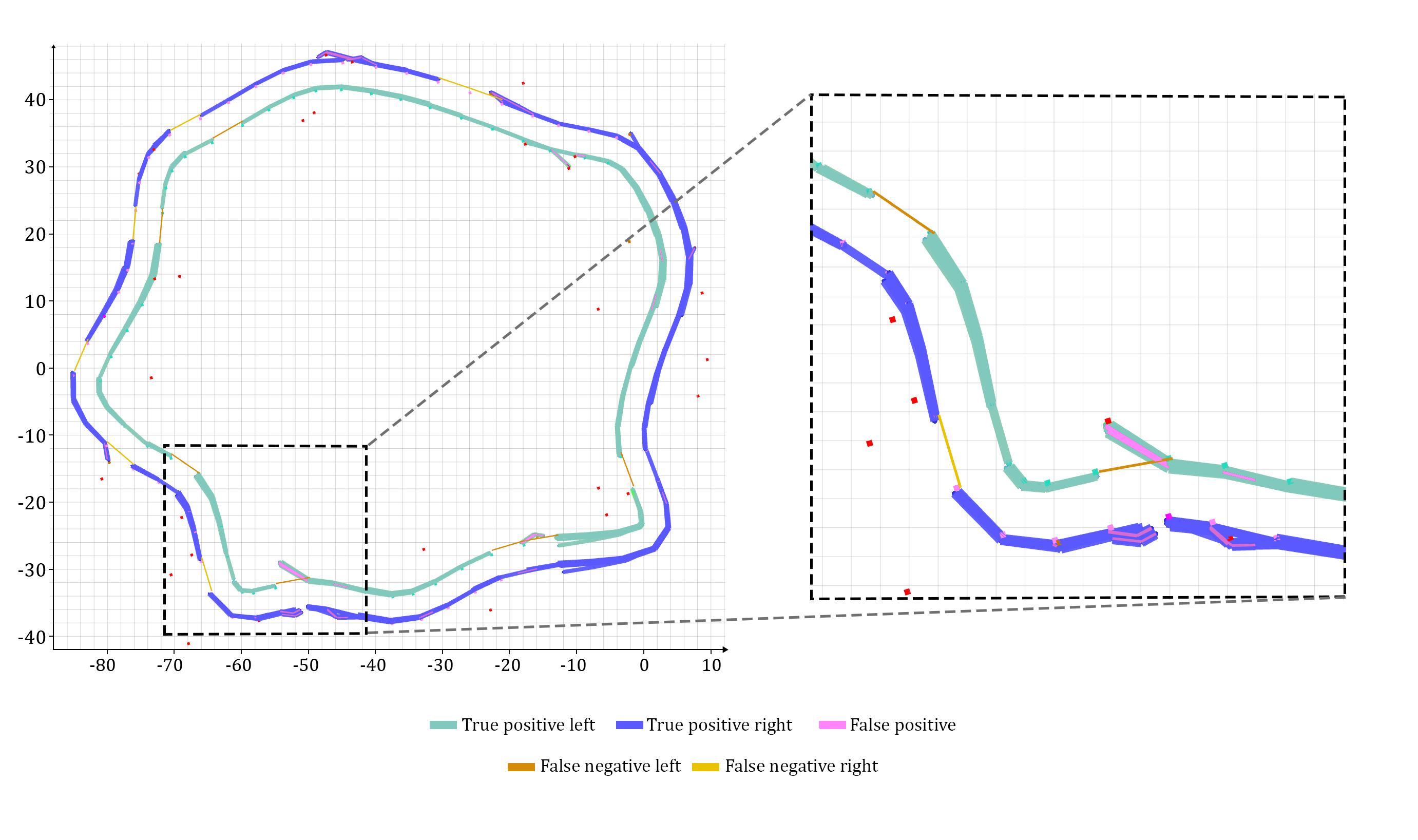
First image description.
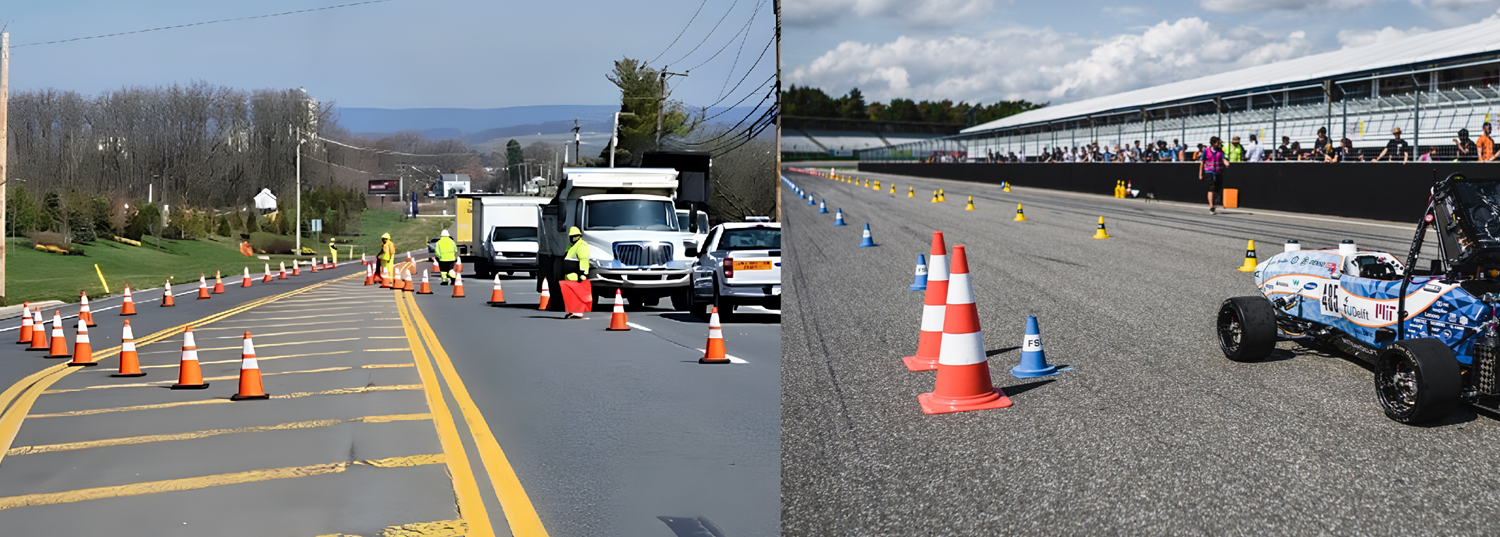
Two traffic scenarios illustration. Source: edgerton.mit.edu and summitflagging.com
BibTeX
@article{YourPaperKey2026,
  title={TODO: Paper Title Here},
  author={First Author and Second Author and Third Author},
  journal={Conference/Journal Name},
  year={2026},
  url={https://jkk-research.github.io/lane_boundary_detection/}
}